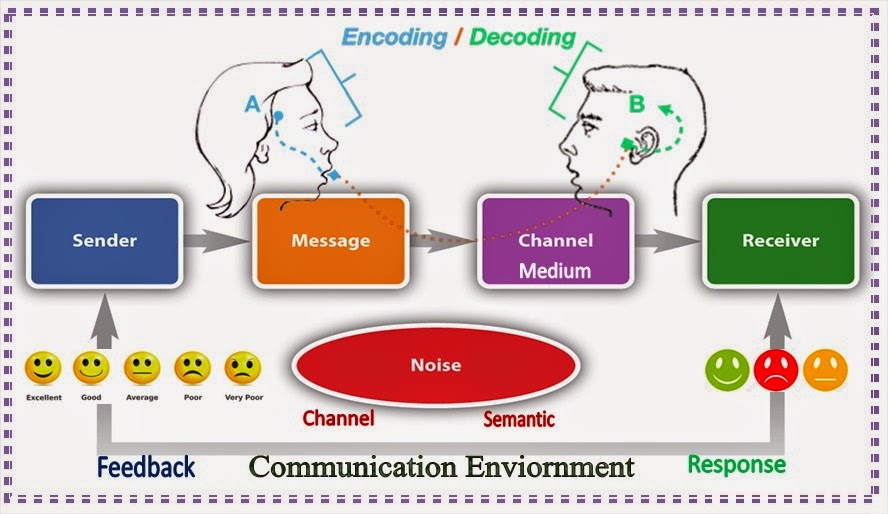
Communication is simply the act of transferring information from one place, person or group to another.
Nature of Communication
1. Communication is a process
2. Communication occurs between two or more people (the speaker and the receiver).
3. Communication can be expressed through words (verbal), action (nonverbal), or both at the same time.
Elements of Communication
Completeness
The message must be complete and geared to the receiver’s perception of the world. The message must be based on facts and a complex message needs additional information and/ or explanation. A good subdivision of subjects will clarify the message as a result of which there will be a complete overview of what is said.
Concreteness
Concrete business communication is also about a clear message. This is often supported by factual material such as research data and figures. The words used as well as the sentence structure can be interpreted uni-vocally. Nothing is left to the imagination.
Courtesy
In addition to considering the feelings and points of view of the target group, it is also important to approach the audience in a friendly and courteous manner. Use of terms that show respect for the receiver contribute towards effective communication. The same goes for the manner in which you address someone. Not everyone will be charmed if you use a familiar form of address and use of a formal address could come across as too distant. By using the word ‘they’ a larger audience is immediately addressed.
Correctness
A correct use of language has the preference. In written business communication, grammatical errors must be avoided and stylistic lapses or a wrong use of verbs are not sufficient either in verbal communication. A correct use of language increases trustworthiness and the receiver will feel that they are taken seriously.
Clarity
Clear or plain language is characterized by explicitness, short sentences and concrete words. Fuzzy language is absolutely forbidden, as are formal language and cliché expressions. By avoiding parentheses and keeping to the point, the receiver will get a clear picture of the content of the message. Briefly-worded information emphasizes the essence of the message.
Consideration
Communicating with the target group (Consideration). In order to communicate well, it is important to relate to the target group and be involved. By taking the audience into account, the message can be geared towards them. Factors that play a role in this are for example: professional knowledge, level of education, age and interests.
Conciseness
A message is clear when the storyline is consistent and when this does not contain any inconsistencies. When facts are mentioned, it is important that there is consistent, supporting information. Systematically implementing a certain statement or notation also contributes to clear business communication. When statements are varied, they will confuse the receiver.

 educational