The Cone of Experience
“The cone is a visual analogy, it does not bear an exact and detailed relationship to the complex elements it represent.” – Edgar Dale’s
8M’s of teaching and each element contributes to ensuring effective instruction.
The Eight M’s of Teaching
1. Milieu – the learning environment
2. Matter – the content of learning
3. Method – teaching and learning activities
4. Material – the resources of learning
5. Media – communication system
6. Motivation – arousing and sustaining interest in learning
7. Mastery – internalization of learning
8. Measurement – evidence that learning took place
Edgar Dale’s Cone of Experience relates well with various instructional media which form part of the system’s approach to instruction.
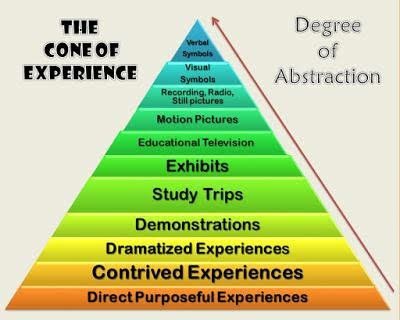
The Band in Dale’s Cone of Experience
Direct purposeful experience – These refer to foundation of experiencing learning. Using senses, meaningful knowledge and understanding are established. This is experiential learning where one learns by doing.
Contrived experience – It is in this category that representation such as models, miniatures, or mock ups are used. There are things or event that may be beyond the learners grasp and so contrived experiences can provide a substitute.
Dramatized experience – These are commonly used as activities that allows students to actively participate in a reconstructed experience through role playing or dramatization.
Study trips – These are actual visits to certain location to observe a situation or a case which may not be available inside the classroom.
Exhibits – These are displays of models such as picture, artifacts, posters, among others that provide the message or information. These are basically viewed, however, there are currently exhibits that allow the viewers to manipulate or interact with the display and as a result, the exhibit becomes more engaging and fun.
Television and motion pictures – These technology equipment provide a two dimensional reconstruction of a reality. These allow leaners to experience the situation being communicated through the mediated tools. They provide a feeling of realism as viewers try to understand the message portrayed by actors in the films.
Still pictures, Recordings, Radio – Still are picture or image. Together in this category are the audio – recorded materials or information broadcast through the radio.
Visual symbols – These are more abstract representations of the concept or the information. Examples of these are information presented through a graph or a chart. For example, a process can be presented using a flow chart.
Verbal symbols – This category appears to be the most abstract because they may not exactly look like the concept or object they represent but are symbols, words, codes or formulae.

 educational